
 Skip to content


Disruption of stagnant water sector can’t happen soon enough

From taxis to holiday accommodation and banking to music, few industries have escaped the effects of disruptive technology.
But what about water?
For this Perspectives article, Director: Key Accounts, Marlowe Environmental Services, Jon Greaves, explains the sector has largely avoided disruption – but that things are going to change fast. What’s more, Jon believes the wave of transformation is long overdue.
The region around my hometown of Matlock, Derbyshire, has lots of beautiful lakes and wetlands. As a boy, I remember the abundance of water; it would never have occurred to me that such places might dry up. But that’s what’s happening with increasing regularly each summer.
Perhaps the most dramatic example is Woodhead Reservoir in Derbyshire. There were shocking pictures last year showing the expanse of dry, brown silt on the bottom. Those images really demonstrate the increasing problem of water scarcity in the UK. In fact, the Environment Agency predicts a potential 6bn litre daily water shortfall by 2055.
Water is taken for granted
Regardless of what the figures say, there’s a tendency to take water for granted. It simply appears, clean and usable, straight from the tap. But what happens when you turn on the tap and no water comes out because reservoirs are dry? It almost sounds unbelievable – something too farfetched that would prompt a whole new way of life.
In fact, the threat of water scarcity is being taken extremely seriously. The latest five-year water industry regulatory period, Asset Management Period (AMP) 8, is intended to drastically improve water infrastructure, stopping leaks and minimising wastewater overflows. There’s a lot of work to do to achieve these aims before the cycle concludes in March 2030. And technology will be key.

Water industry must catch up with tech
When it comes to disruptive technology, why is the water industry so far behind the curve compared to other sectors? I would argue the industry is driven by standards and legislation like Approved Codes of Practice (ACOP) for Legionella control and general Health and Safety Guidance (HSG). These have prioritised doing things manually.
While you can buy a doorbell for £50 that allows you to see outside your house, as well as speak to any callers, the water industry needs to catch up with this kind of technology. We send someone in a van to find out what’s going on – even for something as simple as a temperature reading. Historically this is what the legislation prompted, so perhaps the water hygiene industry stagnated more than others. Compared to the automation we see across facilities management, in cleaning and security for example, water is further behind.
Things are changing – and that can only be a good thing. With both prices and scarcity on the increase, there are parallels between water challenges and the difficulties faced by the energy industry.
A glimpse into the future of water
But what does the future of water look like? It will be shaped by sensors, data and remote monitoring. For example, we’ve been working with a large hotel chain. They have several hundred hotels and spend over £8m a year on water. If we can stop leaks across their sites, it will have a material impact on their spend. Thanks to data pulled from across their portfolio, we were able to flag the properties showing abnormal volumes of water usage. The chain is investigating and will be able to fix any leaks or other causes of excessive water use.
Remote monitoring, which has been around for a while, is now becoming more accessible and flexible to use. Despatching colleagues in vans for simple tasks like taking a temperature reading in some cases will no longer be necessary. Thanks to sensor technology, this can be done automatically. There is also a logistical benefit. Often sites have tight and onerous security processes, which can demand temperature probes are cleared, as well as escorts for visitors. Remote readings mean these are no longer required.
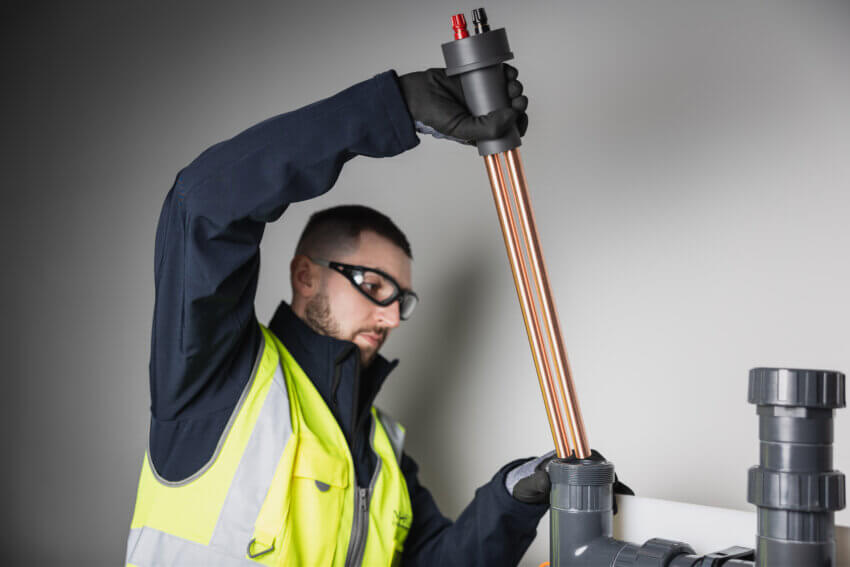
Sensor technology is also transforming the technical side of the industry, such as wastewater and process water treatment. For example, sensors monitor vibrations in equipment, like fans, and flag anomalous readings. Instead of a fan breaking down and interrupting processes, you get a notification that it may need attention. Downtime isn’t a problem because the client has time to conduct the maintenance. This isn’t only more cost effective, but also gives peace of mind that equipment won’t just fail and force a costly shutdown.
Embedding tech will transform water industry
In the next 10 years, water will be managed in much the same way as energy. A lot of basic tasks will be automated and clients will get a single view of their water, air, energy and more – all within one ‘pane of glass’ on a risk dashboard. Water will be part of wider environmental compliance, driven by exception-led control, rather than people-led control.
In the meantime, I expect that as the adoption of disruptive technology increases, new water legislation will play catch-up. It’s still early days, but there have been baby steps in that direction, particularly in Healthcare. A new Health Technical Memoranda (HTM) Technical Bulletin requires remote monitoring of water outlets and loops for hospital refurbishments and newbuilds. I think on the next amendment of ACOP and HSGs, some of the technology will be incorporated into the ‘How to do it’ aspect of the guidance. This will help embed tech into water processes, transforming the industry in the process.
There’s no doubt water has lagged behind other industries and has avoided major disruption until now. That’s all about to change. Faced with the risk of no water in our taps, we’re making a step in the right direction. If anything we need to speed things up.

Read next
Water industry must get its AMP ducks in a row
The UK water sector began AMP8 last April facing a clear contradiction. Linked to the Government’s commercial water reduction targets of 9% by 2038 and 15% by 2050 from 2019/20 baselines, there is a…
Achieving water reduction targets boils down to starting now
The urgency for organisations to get to grips with water strategy as legislation tightens was loud and clear during Mitie’s most recent webinar. ‘Obligation to opportunity: Water risk, regulation and readiness’ built on the content of the Net Zero…
Net zero and the pivot senior leaders can’t ignore
There was a clear consensus among leaders at our latest Net Zero Navigator breakfast briefing – and the outlook was positive. ‘The Net Zero Pivot: From Purpose to Value’ event established that for the most successful organisations there’s been a step-change – net…